
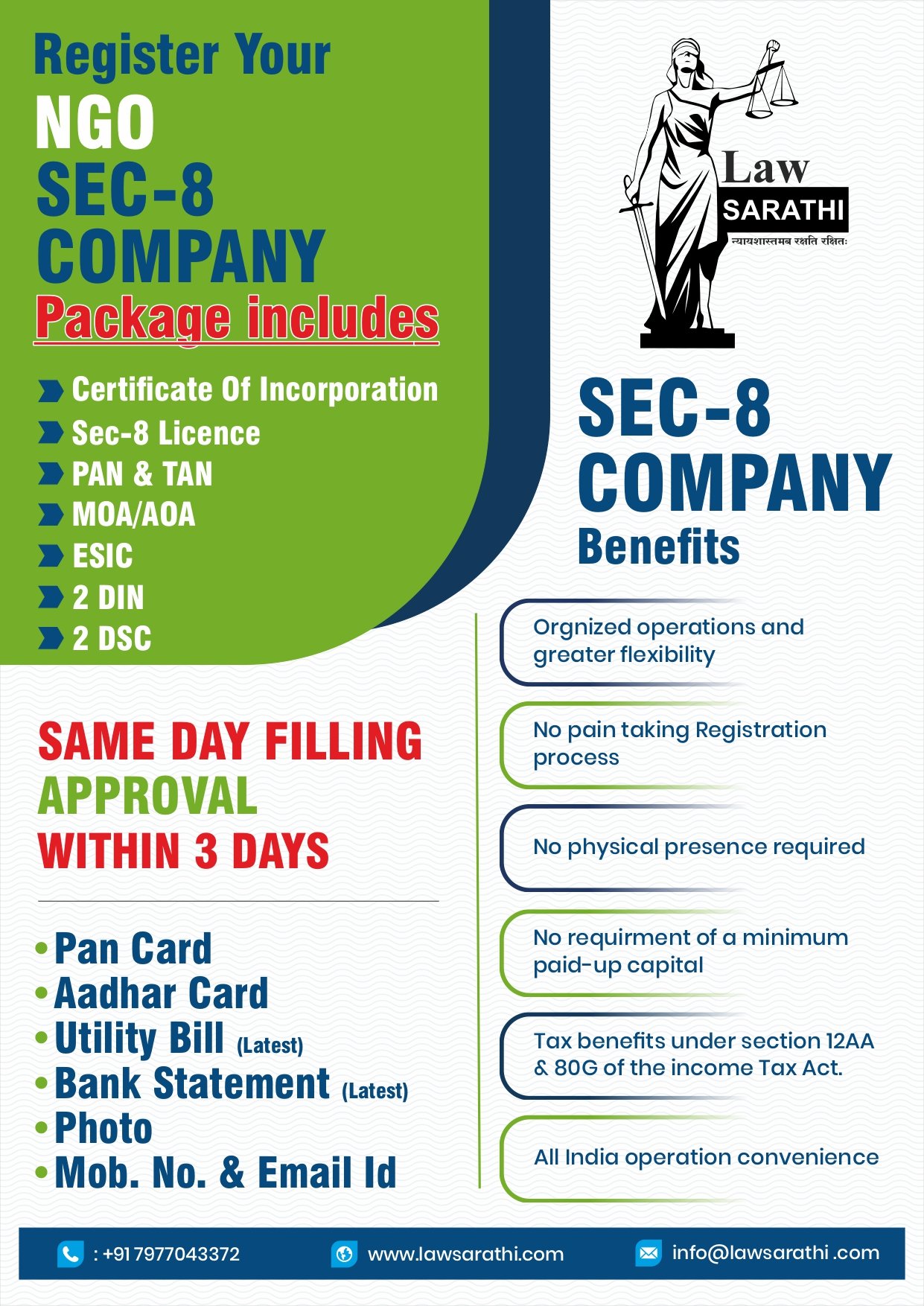
Section 8 Company Registration
A Section 8 Company is a non-profit organization that aims to promote charitable activities, art, science, education, and sports. The profits of such companies are utilized for promoting these objectives and are not distributed among the Company’s members. It is essential to understand what is Section 8 company, document requirements, and company incorporation process.
At Law Sarathi Legal Services, we provide end-to-end services for registering Section 8 companies in India. Our team of experts offers hassle-free and professional services to help you establish a Section 8 company quickly and efficiently. Contact us today to avail of our professional services for registering your Section 8 Company in India.
What is Section 8 Company? – Companies Act, 2013
According to the Companies Act 2013, a Section 8 company means an organization whose objectives are to promote arts, commerce, science, research, education, sports, charity, social welfare, religion, environmental protection, or other similar activities goals. These entities utilize their profits to achieve their mission and do not distribute dividends to their shareholders.
Overview of Section 8 Company Registration
A Section 8 Company is a type of corporation established to promote non-profit activities, such as education, social welfare, environment preservation, arts, sports, charity, and more. This follows the provisions of the Companies Act 2013.
The essential purpose of registering a Section 8 Company is to encourage non-profitable goals, including but not limited to trade, arts, commerce, education, charity, environmental protection, sports research, and social welfare. To register a Section 8 Company, a minimum of two directors are required, and there is no requirement for a minimum paid-up capital to set up such a company.
Key Points about Section 8 Company Act
In India, Non-Governmental Organizations (NGOs) can be registered under the Registrar of Societies or as a non-profit entity under Section 8 Company of the Companies Act, 2013.
Profit generated by Section 8 Companies cannot be used for purposes other than charitable objectives and cannot be distributed among shareholders.
Section 8 Companies are similar to the erstwhile Section 25 Company under the Company Act 1956. As per the prevailing Company Act, these are now recognized as Section 8 Companies.
Section 8 Companies are required to comply with the provisions of the Companies Act 2013. They are mandated to maintain books of accounts, file returns with the Registrar of Companies (ROCs), and comply with GST and IT Act.
Any changes to the charter documents like the Articles of Association (AoA) and Memorandum of Association (MoA) require the government’s consent.
Benefits of Opening a Section 8 Company in India
Tax Exemption
Section 8 companies registered under section 12AA of the Income Tax Act are eligible for a 100% tax exemption, as they utilize their profits for charitable purposes. This is a significant benefit as the profits generated by such entities are non-taxable.
No Minimum Capital Requirement
Unlike public limited companies, Section 8 entities do not have a minimum capital requirement. They can adjust their capital structure according to their growth, giving them more flexibility.
Separate Legal Entity
Section 8 companies have a separate legal identity and perpetual existence, just like other registered companies. This increases their credibility and provides them with more autonomy and legal standing.
Increased Credibility
Section 8 companies are subject to strict legal compliance frameworks, enhancing their credibility regarding legal standing. Unlike NGOs and trusts, Section 8 entities follow stringent compliances post-registration, making them more trustworthy.
No Title Required
Section 8 companies are free to choose a name that suits their liking during the registration process. Unlike other registered structures, they are not required to affix the term “Section 8” after their name.
A Section 8 company in India offers numerous benefits, including tax exemption, no minimum capital requirement, no need to pay stamp duty, separate legal identity, increased credibility, and no title required. These advantages make Section 8 companies attractive for entrepreneurs looking to start a business with a charitable or social cause.
Who can Form a Section 8 Company?
An Indian national or Hindu Undivided Family (HUF) can incorporate a Section 8 Company.
The entity must have at least one director.
The primary object of the Section 8 Company Act should be related to promoting art and science, sports, charitable activities, education, or providing financial assistance to individuals from lower-income groups.
These eligibility criteria ensure that the Section 8 Company operates to promote social welfare and contribute to the greater good of society.
Mandatory Legal Requirements for Incorporation of Section 8 Company
Number of Directors
Minimum two directors for a private limited structure
Minimum three directors for a public limited structure
Number of Members
Private limited: Maximum 200 members
Public limited: No limit
Capital Requirement and Name
No minimum paid-up capital required
No requirement to use “Private Limited” or “Limited” in the name
Company Objects
Only entities with non-profit objectives are eligible. Profits must be reinvested for charitable purposes and cannot be distributed to members.
Documents Required for Section 8 Company Incorporation
Articles of Association (AOA)
Memorandum of Association (MOA)
Declaration by first directors and subscribers
Proof of registered office address
Certificate of incorporation (if overseas body involved)
Resolution by promoter company
Consent of nominee (INC-3)
Identity & address proof of directors and subscribers
Digital Signature Certificate (DSC)
Declaration of unregistered companies
Section 8 Company Incorporation Process
Step 1: Obtain Digital Signature Certificate (DSC)
Forms: DIR-3, DSC
Step 2: Obtain Director Identification Number (DIN)
Forms: DIR-3
Step 3: Reserve Company Name
Forms: INC-1
Step 4: File Application for Incorporation
Forms: INC-32, MOA, AOA
Step 5: Obtain Section 8 License
Forms: INC-12
Step 6: Certificate of Incorporation
Forms: INC-16
Donations / Funding of Section 8 Company
Public donations permitted
Foreign donations require FCRA registration (after 3 years or prior permission)
Equity funding through premium shares
Domestic donations allowed with AML safeguards
Registration under Section 12AA and 80G
Section 12AA grants income tax exemption.
Section 80G allows donors to claim tax deductions.
Important note:
For Section 8 companies, the validity of 80G registration is till March 2025 and must be renewed for AY 2025–2026.
Law Sarathi Legal Services makes your Section 12AA and 80G registration seamless, helping your Section 8 company secure tax exemptions and attract more donors with ease.
Streamline Section 8 Company Registration with Law Sarathi Legal Services
Law Sarathi Legal Services is a trusted partner for entrepreneurs and organizations looking to obtain Section 8 company registration in India. With expert guidance and a seamless process, we simplify documentation, compliance, and approvals—helping you establish a strong, credible non-profit organization focused on social welfare and charitable impact.
📞 Contact us now to begin your Section 8 company registration journey.